 Floki
Floki transfers can need a replacement when a transaction remains pending
Floki transfers can benefit from a retry when the original transaction remains pending because its fee bid is insufficient. For a transfer from an ordinary wallet account, a replacement must use the same sender, network and nonce with an adequate fee increase. First check whether the original already succeeded: submitting another transfer with a new nonce can send the tokens twice.
Updated:A wallet’s pending label doesn’t establish what happened on the network. The transaction hash, execution receipt and token transfer record distinguish an unprocessed request from a completed transfer whose balance display hasn’t caught up.
The short version: A replacement competes for the original transaction’s nonce, while a fresh transfer can send the tokens again if both transactions succeed.
Earlier nonces can hold up later transfers
A pending transaction can delay later transactions from the same account, even when those later requests offer higher fees. The nonce identifies a transaction’s position in that account’s sequence. An ordinary Ethereum account’s transactions execute in increasing nonce order. An unresolved earlier nonce therefore affects more than the transfer currently open in the wallet.
FLOKI operates on Ethereum and BNB Smart Chain, so diagnosis starts with the network carrying the transfer. An account’s activity on one chain doesn’t fill a nonce gap on another. Within the affected chain, inspect the earliest unresolved transaction. It could be a token approval or another contract interaction rather than the transfer you’re trying to complete.
What does a pending transfer actually mean?
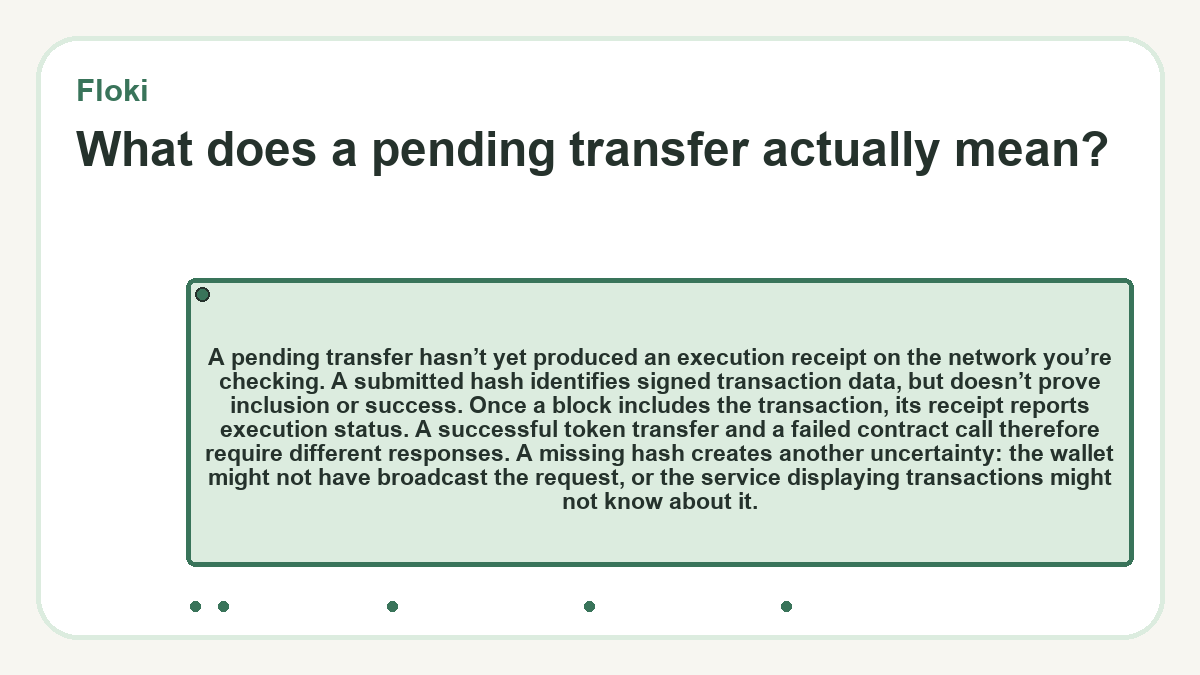
A pending transfer hasn’t yet produced an execution receipt on the network you’re checking. A submitted hash identifies signed transaction data, but doesn’t prove inclusion or success. Once a block includes the transaction, its receipt reports execution status. A successful token transfer and a failed contract call therefore require different responses. A missing hash creates another uncertainty: the wallet might not have broadcast the request, or the service displaying transactions might not know about it.
Gas settings change cost and execution limits
Fee adjustments affect what the sender offers for processing; they don’t change the FLOKI amount encoded in an otherwise unchanged transfer. The execution fee equals the gas used multiplied by the effective price per unit of gas. A higher fee ceiling permits a higher charge without establishing the final charge in advance.
The bid and the gas limit
Price per unit of gas
Ethereum’s EIP-1559 transactions specify a maximum fee per gas and a maximum priority fee per gas; legacy transactions specify a gas price. The maximum must accommodate the applicable base fee, while the priority fee influences the incentive to include the transaction. A replacement also needs to satisfy the receiving node’s fee-bump rules. There’s no universal percentage increase that fixes every pending transaction.
Allowance for computation
The gas limit caps how much computation the transaction may consume. Increasing it doesn’t raise the bid per unit. Setting it too low can cause execution to run out of gas. Token transfers call a contract, so copying the limit for a simple native-coin transfer can be inappropriate.
The balance paying the fee
An ordinary sender pays Ethereum gas in ETH and BNB Smart Chain gas in BNB. Holding enough FLOKI doesn’t establish that the account can fund its network fee. The balance must cover the transaction’s upfront requirements on the same chain.
A higher bid can make processing more attractive, but it can’t supply missing funds or remove an earlier nonce gap. Keep those causes separate before changing another setting.
When is a replacement worth attempting?
A replacement is useful when the original remains unprocessed, the transfer is still wanted and an inadequate fee bid explains the delay. A wallet’s supported speed-up function can preserve the transfer details while adjusting fees. Waiting remains reasonable when the existing bid can become acceptable and completion isn’t urgent. Cancellation also uses a competing transaction; it succeeds only if its replacement takes the nonce before the original. Neither option reverses an already completed transfer.
Following a pending transfer through replacement and receipt
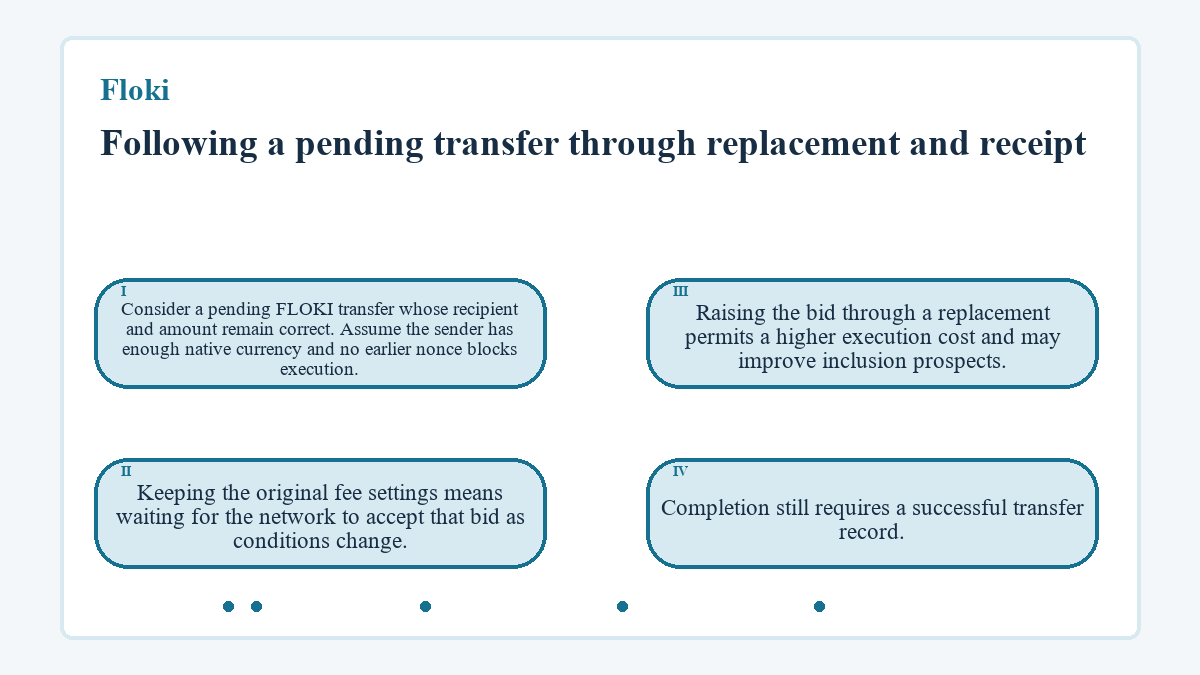
Consider a pending FLOKI transfer whose recipient and amount remain correct. Assume the sender has enough native currency and no earlier nonce blocks execution. Keeping the original fee settings means waiting for the network to accept that bid as conditions change. Raising the bid through a replacement permits a higher execution cost and may improve inclusion prospects. Completion still requires a successful transfer record.
| Stage | Action | Observable record | Execution conditions and limits |
|---|---|---|---|
| Locate the original | Match the sender, network and hash | Transaction details | The record identifies the intended transfer |
| Establish its state | Inspect inclusion and earlier nonces | Pending request without a receipt | No earlier nonce prevents execution |
| Prepare the replacement | Keep transfer data and nonce; revise fees | Wallet transaction review | The original remains pending and funds cover the fee requirements |
| Submit the replacement | Sign and broadcast the revised request | A different hash using the original nonce | Node acceptance doesn’t establish completion |
| Inspect execution | Identify which competing transaction entered a block | Receipt and execution status | Only one transaction can consume that account nonce in the canonical chain |
| Reconcile delivery | Match the token transfer and receiving balance | Recipient, amount and token contract | Any receiving service’s confirmation requirement also applies |
If the original succeeds during preparation, stop the replacement attempt and reconcile that receipt. A rejected replacement doesn’t cancel the original. If execution fails, the assumption that a fee adjustment alone would complete the transfer no longer holds.
Read the token transfer behind a successful status
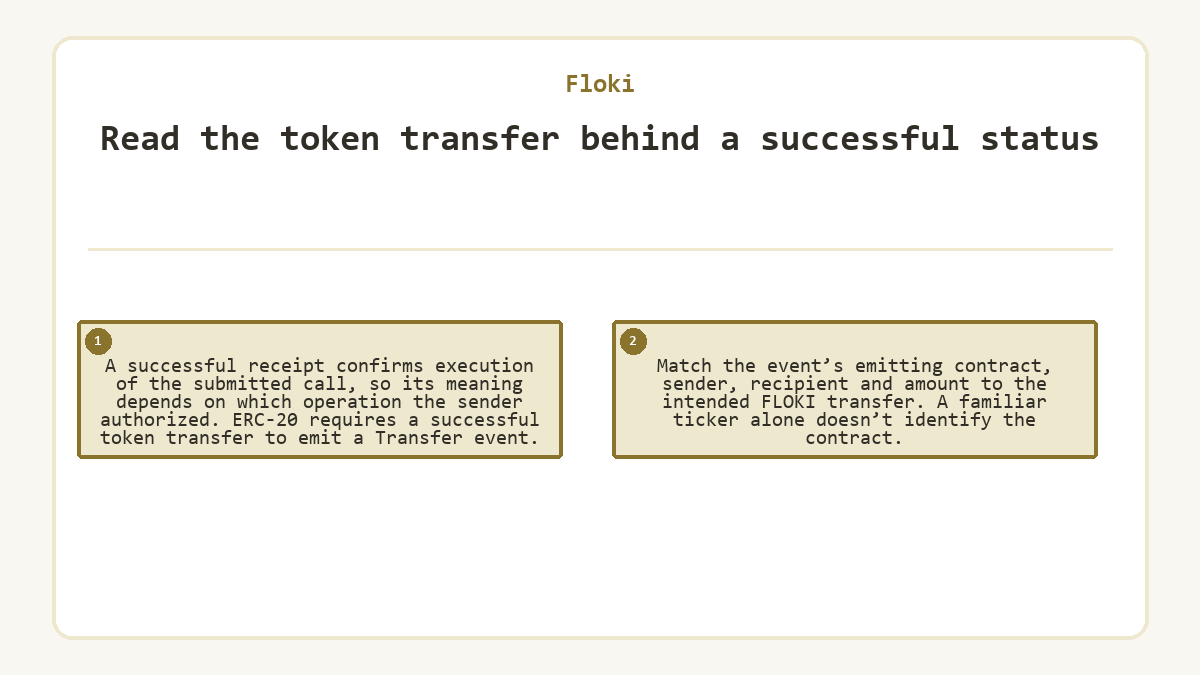
A successful receipt confirms execution of the submitted call, so its meaning depends on which operation the sender authorized. ERC-20 requires a successful token transfer to emit a Transfer event. Match the event’s emitting contract, sender, recipient and amount to the intended FLOKI transfer. A familiar ticker alone doesn’t identify the contract.
An approval has a different result: it grants spending permission without completing the later transfer or staking deposit. If the successful transaction only approved a spender, repeating that approval won’t complete the intended deposit. Check the actual operation before treating a green status indicator as proof the whole task finished. This distinction matters whenever an application separates authorization from execution.
Can a failed transaction be retried?
A transaction with a failed execution receipt can be retried as a new transaction after the cause of failure changes. Inclusion has already consumed its nonce. The failed call’s state changes revert, but the sender still pays for computation performed. Repeating unchanged inputs can therefore produce another failure and another gas charge.
An out-of-gas failure concerns the computation limit, while a contract revert can reflect an unmet contract condition. An insufficient token balance or spending allowance requires a different correction from an inadequate fee bid. Read the error and the submitted operation together. A wallet’s failure notification without an on-chain receipt needs further diagnosis before you treat it as an executed failure.
Missing hashes and delayed balances need reconciliation
A transaction absent from one explorer isn’t proof that every network node has discarded it. Check the selected chain and the sender’s transaction history, including replacements. A dropped transaction may remain known elsewhere while its nonce is unused. Clearing local wallet activity only changes the wallet’s records; it doesn’t cancel a request already broadcast to the network.
When a successful transfer exists but a receiving service hasn’t credited it, another send adds a separate transfer. The service may require additional confirmations or need to reconcile its records. Its supported network and deposit conditions govern crediting. Preserve the successful hash and transfer details while resolving that discrepancy. For a direct transfer, the relevant contract record is the ERC-20 Transfer event.
Frequently asked questions about Floki
Does closing my wallet cancel a pending FLOKI transfer?
Closing the wallet doesn’t cancel a transaction already broadcast to the network. Nodes can continue processing it while the application is closed. Reopening the wallet may refresh a stale display, but the transaction’s network status determines whether it remains pending.
Can the recipient speed up my pending transfer?
The recipient can’t replace an ordinary transaction signed by your account. A replacement requires authorization from the sending account and must use its pending nonce. Receiving the tokens doesn’t give the recipient control over the sender’s transaction sequence.
What happens if I submit transactions from two devices using the same account?
Both devices use the same account’s nonce sequence on the selected network. They can propose competing transactions at the same nonce or create a queue their local displays interpret differently. Compare both devices’ submitted hashes before signing another request.
Will canceling a pending transfer remove an earlier token approval?
Canceling a pending transfer doesn’t revoke a separate approval that already succeeded. That approval changed the token contract’s spending allowance. Changing the allowance requires its own authorized operation, which can also require a network fee.
How does a replacement transaction affect the tracking hash?
A replacement has a different hash because its signed transaction data changes. Keep both hashes until you identify the included transaction. The original hash may remain visible as replaced or dropped even when the replacement completes the intended transfer.
Is the gas fee refunded when a cancellation succeeds?
A successful on-chain cancellation consumes gas and incurs its own execution fee. The original transaction doesn’t also incur an execution fee if the cancellation consumes their shared nonce first. Sending a fresh transfer afterward creates a separate charge.
When should I stop increasing the fee after a replacement is rejected?
Stop treating the problem as insufficient fees when the rejection identifies another cause, such as insufficient funds or an already-used nonce. Check the original and replacement records again. A higher bid can’t restore a nonce an included transaction has consumed.